The VPS Latency Advantage: Why Milliseconds Make or Break Your Trades
Written by MarginVPS Infrastructure Team
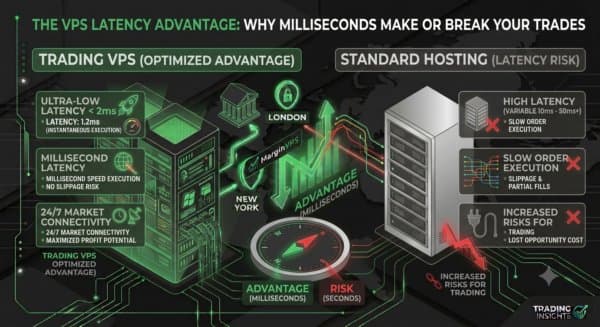
Discover how <1ms execution times give professional traders a measurable edge in volatile Forex and crypto markets.
In liquid markets, price moves in microseconds. The time between your EA generating a signal and your broker confirming the fill determines whether you execute at your intended price — or somewhere worse.
This is the latency advantage: the measurable, quantifiable edge that comes from placing your trading server physically close to the matching engine.
What Is Latency in Trading?
Latency is the time it takes for a data packet to travel from your trading terminal to the broker’s server and back. It is measured in milliseconds (ms) or, for co-located servers, microseconds (µs).
Every order you place travels this path:
- Your EA fires an order signal
- MetaTrader serialises it and sends it over the network
- The broker’s server receives it, checks margin, and matches it
- The fill confirmation travels back to your terminal
Each hop adds delay. The further you are from the broker’s server, the more hops, and the more total latency.
How Latency Affects P&L
Slippage is the most direct cost. When you send a market order at 1.08500, the price has moved by the time it arrives at the broker if you have high latency. Brokers fill you at the best available price — which may be 1.08503 or worse. On a 1-lot position in EUR/USD, three pips of slippage costs $30 per trade.
For a scalper executing 20 trades per day, 3 pips of average slippage at 1 lot per trade = $600/day in hidden costs.
Requotes increase with latency. The broker sees the market move between receiving your order and processing it, and offers you the new (worse) price. High-latency connections see 5–10x more requotes than co-located servers.
EA execution gaps — some strategies open and close positions within a few seconds. With 80ms ping, a fast news-trading EA can miss its entry window entirely.
The Numbers: Home PC vs. Co-Located VPS
| Setup | Typical Latency | Slippage (1 lot) |
|---|---|---|
| Home PC, UK ISP → LD4 broker | 18–35ms | 1.5–3 pips avg |
| Cloud VPS, same region | 4–8ms | 0.5–1 pip avg |
| Co-located VPS, Equinix LD4 | 0.3–0.8ms | Near zero |
The difference between a home connection and co-location is not marginal — it is 30–100x.
Which Strategies Benefit Most?
Scalping and tick scalping — every microsecond matters. <1ms execution is the difference between a profitable strategy and a losing one.
News trading — first to fill wins. Latency determines whether you get the initial spread or the one after the spike.
Grid and martingale EAs — rapid order placement during volatile moves requires reliable, low-latency execution.
Copy trading — signal replication depends on speed. High latency causes your fills to lag the master account.
How to Measure Your Current Latency
In MetaTrader 4 or 5, open the Journal tab. After a trade executes, look for the line:
order executed in X ms
If this is consistently above 10ms, you are leaving money on the table. Above 50ms, your strategy is operating at a significant disadvantage.
Getting the Latency Advantage
The single most effective way to reduce trading latency is to move your MetaTrader instance to a VPS co-located with your broker:
- Equinix LD4 (Slough, UK) — home to IC Markets, Pepperstone, FP Markets, FXCM EU
- Equinix NY4 (Secaucus, NJ) — home to Interactive Brokers, OANDA, TD Ameritrade
- Equinix FR2 (Frankfurt) — Deutsche Börse, many EU-regulated brokers
- Equinix TY3 (Tokyo) — GMO Click, SBI, most JP brokers
<1ms latency from any of these locations is achievable with the right VPS.
Ready to stop losing milliseconds to your home connection?
MarginVPS runs your MT4, MT5, or cTrader terminal on a low-latency VPS inside your broker's data center — from $16.67/mo, with an extra 20% off using code EXTRA20OFF.
View VPS Plans →